Call Now


How to measure for Awnings | 247 Guides
Getting your measurements right is the most important step in ensuring a smooth installation and a perfect fit. This measuring guide will take you through everything you need to know, helping you capture accurate dimensions for your space with confidence.
Whether you're planning for an open cassette, full cassette, or electric full cassette awning, the same core measuring principles apply. Taking the time to measure correctly will help you avoid common issues and ensure your awning performs exactly as expected.
Once you have your measurements ready, you’ll be set to move on to the fitting guide with confidence. Let’s get started.
Looking for similar guides?
View our how to fit Open Cassette Awnings guide below, or view the fitting page here
View our how to fit Full Cassette Awnings guide below, or view the fitting page here
View our how to fit Electric Full Cassette Awnings guide below, or view the fitting page here
Whilst our awnings aren’t made to measure, there are still some important things to check before deciding whether one will work in your space.
What you’ll need: A sturdy metal tape measure and chalk / a light coloured pencil.
STEP 1 - MARK THE HEIGHT AND CHECK THE WALL
FITTING ABOVE A DOOR/WINDOW
First, measure 450mm up from the top of the window or door you’re planning to fit the
awning above.
FITTING TO A CLEAR WALL
If you’re fitting it to a wall without a door, measure up from the ground instead. We
recommend installing the awning at least 2500mm high.
Using chalk or a pencil, mark the row of bricks at the top of your measurement. If the measurement lands on the mortar between two rows, mark the brick row above instead.
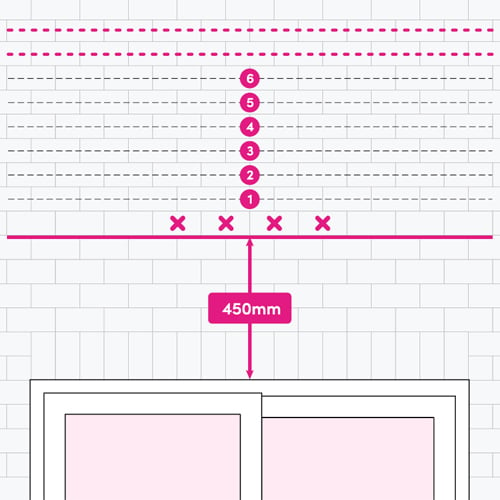
It’s best to check there’s nothing in the way between the top of your window or door and the row you’ve marked, such as outdoor lights or other fixtures. If there is, you may need to adjust the awning position. You’ll also need to check for any structural damage near the installation area, like large cracks in the brickwork, as this could mean the wall isn’t strong enough to safely support the awning.
Next, count the number of brick rows above the row you’ve marked. You’ll need a minimum of 6 brick rows before any second-storey windows or roofline, allowing enough structural weight above the awning to support it properly.
NOTE: Installing an awning without adequate support above could cause serious structural issues, so it’s important to check.
STEP 2 - MEASURE THE WIDTH
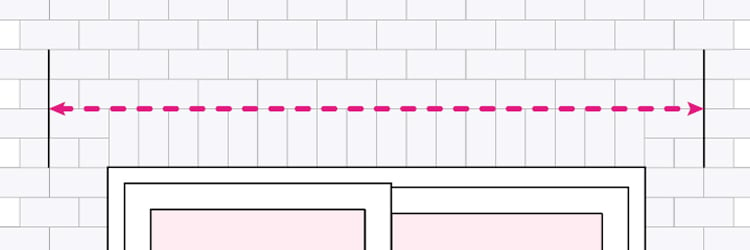
Finding the right width is simple: measure the width of the area you want to cover, then choose an awning that’s wider than that measurement, making sure your wall has enough
room to accommodate it.
STEP 3 - CHECK THE CLEARANCE
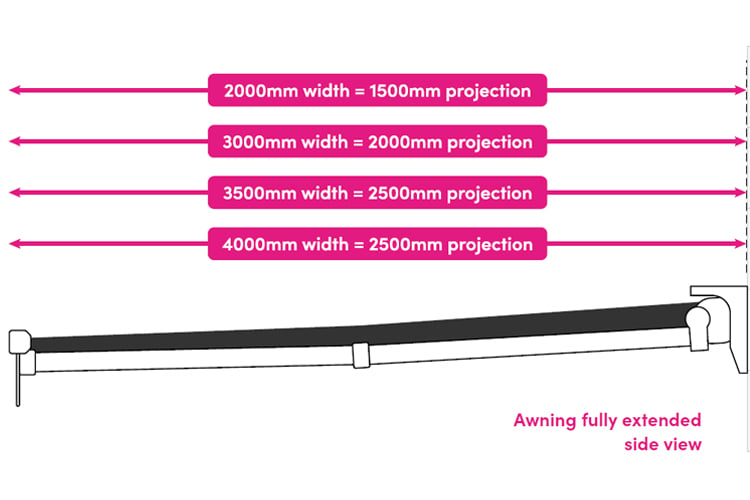
Finally, check there’s nothing in front of the awning that could block its projection, such as trees or garden structures. If you’re fitting the awning into an L-shaped space, don’t forget to check the adjacent wall too, as pipes, lights, or other protruding fixtures could get in the way.